
I kept seeing everyone use Pinterest. Beautiful boards, beautiful pins, beautiful ideas — everywhere.
And I had no idea how they were actually using it.
Was it just a place to save pretty pictures? Was it social media? Was it a hobby? I watched people talk about Pinterest traffic, Pinterest growth, Pinterest income — and I couldn't connect the dots. So I did what I always do when I don't understand something: I searched. I started. I researched.
What I found changed how I see the whole platform. And this post is the good side of Pinterest — the side nobody explained to me at the start.

First, the honest part: I was disappointed
Let me not skip this, because this is where most people quit. I started posting pins, and nothing happened.
No views. No growth. No feeling that anything I made was reaching anyone. I wasn't getting rich — I wasn't even getting seen. And honestly? I wasn't impressed with Pinterest at all. It felt like another app where you post into silence and wait for an algorithm to notice you.
If you're there right now, I get it. I was there too. But the problem wasn't Pinterest. The problem was that I was treating it like social media — and Pinterest is not social media.
The shift: Pinterest feels like a search engine because it IS one
Here's the sentence that changed everything for me: on Pinterest, people don't scroll to pass time — they search to find something.
On a feed app, your post lives for hours and then it's gone. On Pinterest, someone types a problem into the search bar — "side hustle ideas", "digital rose gift", "content calendar" — and a pin from weeks or months ago can still show up, because that person is looking for it right now. That's not a feed. That's a search engine wearing a vision board.
And that means the rules are different. On a feed, timing is everything. On Pinterest, being findable is everything. The question is never "did you post today?" — it's "can the right person find this when they search?"
That one shift — from "posting" to "being found" — is the whole game. And it runs on SEO.
How I started working: SEO, boards, and the image itself
Once I understood that, I stopped posting randomly and started working on the specific functions that actually move a pin:
- Boards, built like search phrases. A board isn't a folder — it's a signal. I started naming boards with the exact phrases people search for, and saving each pin to the one board it truly belongs to, instead of scattering it everywhere.
- Titles and descriptions with keywords up front. The keyword goes in the first words of the title, and the description opens with the main search phrase — because that's what Pinterest reads first.
- Fresh pins, not recycled ones. A new image, a new title, a new description — even for the same link. Duplicates quietly die; fresh pins get a chance.
- The image itself. This is the part that surprised me most. Pinterest's AI can look inside your image and identify what's actually in it — the objects, the scene, the mood. So what I put into the image matters as much as the words around it: a clear subject, a readable offer, and nothing confusing. The image isn't decoration. It's information.
So now, when I create a pin, I'm doing four jobs at once: choosing the words someone would search, writing the title and description around them, picking the right board, and designing an image that tells Pinterest — and the person — exactly what this is, in one glance.
Then, slowly, the views came — and so did the growth
Nothing exploded overnight. I want to be honest about that, because overnight stories are usually fiction.
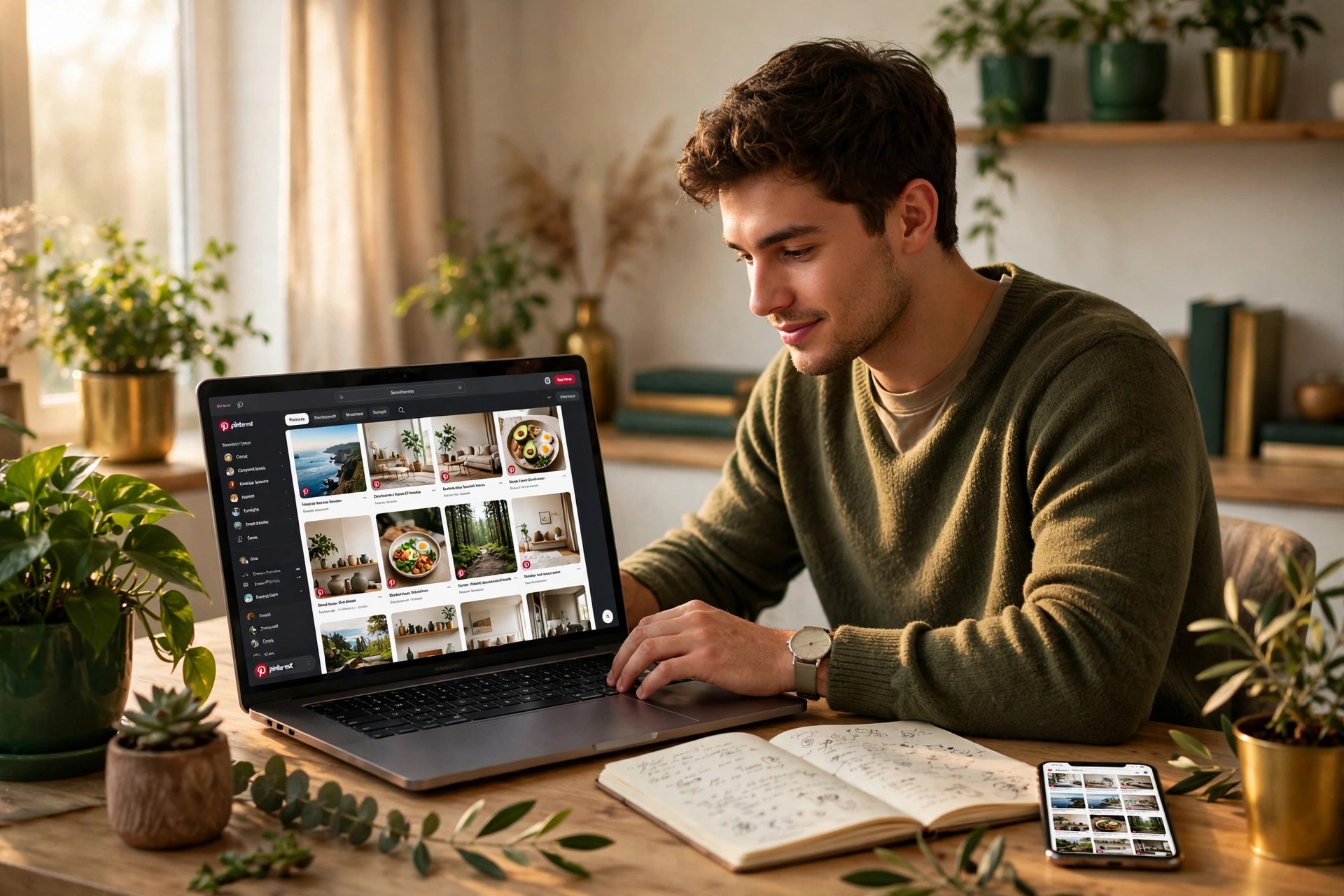
What happened was slower and better: a pin I made weeks ago started getting views from search. Then another. Then the boards started compounding — each good pin making the board stronger, each strong board lifting the next pin. I wasn't chasing the feed anymore. I was building a small library that people kept finding, day after day, while I slept.
That's when I stopped being disappointed. Not because one pin went viral — but because the system started working: search → find → click → come back. A quiet machine, built one pin at a time.
And a machine like that doesn't just give you views. It gives you something to build on. Which brings us to the part everyone asks about.
How you can actually earn from Pinterest — the three ways
Pinterest doesn't pay you for views directly. That's the first thing to understand — and it's actually good news, because it means the earning comes from what the traffic does after it finds you. There are three real ways, and I use all three:
1. Affiliate marketing. You pin a product you genuinely recommend, and the pin links to it with your affiliate link. When someone finds your pin through search, clicks, and buys — you earn a commission. The pin keeps working for months, so one good pin can quietly earn again and again. No shop, no stock, no customer service — just a helpful pin pointing to the right product.
2. YouTube. This is the two-jobs-at-once engine. A pin can link straight to your video — so the same pin that brings blog traffic also brings video views. People who find you on Pinterest watch you on YouTube, and people who watch you on YouTube discover your pins. One piece of content, two channels growing together. That's exactly why I embed my videos in my blog posts too: every reader is a potential viewer, and every viewer is a potential reader.
3. Your own products — digital or anything else. This is my favourite, because it's yours. A pin links to your Gumroad product, your store, your blog post — anything you made yourself. Someone searches for the problem, finds your pin, clicks, and buys what you built. Digital products, printables, planners, templates — or any physical product you sell. The pin is the signpost; your product is the destination. And because Pinterest traffic is search traffic, the people arriving already want what you're offering.
None of these is a trick, and none of them is overnight. They all run on the same foundation: a searchable pin, on the right board, found by the right person, at the moment they're looking. Build that foundation first, and the earning ways are just what you point it at.

The good side, in one line
Pinterest rewards the patient builder, not the loudest poster. If you learn how it actually works — search, SEO, boards, and images that speak clearly — it stops being a pretty app you don't understand, and starts being a quiet engine: views while you sleep, traffic that compounds, and three honest ways to turn attention into income.
I went from disappointed to developing, one pin at a time. Slowly. And slowly is fine — slowly is how anything real gets built.
Want the full system behind this?
This post is one piece of a bigger picture. My guide From Zero Clicks to Income covers the whole all-platform system — SEO explained simply, Pinterest, Instagram, YouTube, X and Threads each with their own rules, and a 30-day plan that tells you exactly what to do each day.
Read the full system the all-platform social media growth system · 26 pages · 3 bonusesAnd to plan your pins day by day, grab the 30-Day Social Media Content Calendar — the exact planning tool I use myself.
Start with one board. One search phrase. One pin made properly. Then do it again tomorrow. Pinterest won't make you rich this week — but it might just be the quietest, most patient growth engine you ever build.

By Anik
I'm building a one-person digital product business in public — planners, printables, and content systems for side hustlers. Everything I share here is something I've actually tried. More about me →